Showing posts with label exercises. Show all posts

Tuesday, April 28, 2015

Jump higher, move quicker - Beach Volleyball Performance Enhancement


Everybody wishes it was bigger.

And when it's time to use it, and it's smaller than everybody else's on the beach, it is most definitely a cause for embarrassment. In fact, it can be such a source of anxiety that it creates a psychological complex, inhibiting potential for future performance.

Your vertical is small, and ignoring that fact won't make the problem go away.

Your lack of ability to get it up and out of the sand may come down to one of, or a combination of the following 3 reasons:
  1. Lack of power
  2. Joint instability
  3. Mechanical sequencing issues
Power Outage
While a greater strength-base offers potential for increased power output, you don't need to be able to deadlift a car to have a 40 inch leap; strength does not directly equate to power. My definition of strength and power (which is admittedly controversial) are as follows: strength is your ability to move objects around your body, and often includes added resistance incumbencies; power is that rate at which you can move your body through space, and the force per interval that your muscles generate. Rather than focusing on how much weight you can move through a power exercise, focus on the speed and efficiency with which you can move the weight. The greatest determinant in power output is muscle-contraction speed, and you would be wise to dedicate half of your power-based workouts to improving your rate of contraction.

Here are 2 exercises to include in your workout program that contribute to an accelerated muscle contraction rate and will almost certainly contribute to more speed in the sand and a higher vertical leap:

1. Knee Jump to Tuck Jumps


2. Resistance Band Hip Flexor & Shoulder Drivers


*You should never perform power exercises to fatigue if you are trying to build power. Once your rate of contraction slows, you are effectively de-training yourself!

Jellyfish Joints
You may have carefully periodized your workout routine over the year, tapering down from 15 reps, to 6, building from endurance to strength, and you have started you power phase...but you aren't jumping any higher...what gives? The problem may be that you neglected to strengthen the muscles that are in charge of joint stability. Your vertical is a product of a transfer of kinetic energy, from your feet through your neck, and is a direct measurement of the downward force you apply to the ground. Accepting the laws of physics, the ground exerts the force back on to your body, which propels you off the ground. Before this force can reach its maximum effect, it must pass through your ankle joints, knee joints, hip joints, and spinal column. Any force that is displaced laterally (anything that is not vertically linear) is wasted potential. In beach volleyball, the sand already creates instability, the last thing you need is to contribute to that instability with weak joints.

Add these 2 exercises to increase hip stability and knee stability:

1. Thera-band Hip Matrix, Forwards/Reverse


2. Lateral/Medial Resistance Band Lunge (front knee)


I Before E, Except at Your Knee
The last reason your vertical is impotent and your first step to dig a line shot is flaccid, is because your mechanics are horrendous. Ok, perhaps "horrendous" is a little aggressive, but improper muscle sequencing not only saps you of power, but actually contributes to chronic injuries like Patellofemoral Pain Syndrom (PFPS, aka. Jumper's Knee). To break it down to its most basic level, PFPS can be the result, in part, of the Vastus Lateralis (outer quad muscle) firing before the Vastus Medialis (inner quad muscle). Proper muscle sequencing, when jumping, is supposed to be medialis first, lateralis second. In addition, some of our strongest muscles, are our laziest. Our Gluteus Maximus (butt muscle) has the potential for great strength and power, but it is extremely lazy if we allow it to be, and it does not like to work when our Quadriceps are capable of taking the load.

Here are 2 extremely easy to do exercises, that will help create proper muscle sequencing within your body:

1. Vastus Medialis Obliques (VMO) activation


2. Gluteal firing sequence (independent of quads)


If you are a few weeks deep in to your power training or don't even do power training, are 3 months out of season or are mid season, you can add these 6 exercises in to any program to enhance your results. In addition to boosting your power and increasing your speed, agility, and vertical jump, they can help keep you from injury and will contribute to better all around body function. Don't find yourself on the beach this summer suffering from leap-ness envy, start these exercises today and watch your confidence grow!

@BrendanRolfe

Image/Video Credits
[1]http://sportfoto.ca/

Friday, March 20, 2015

5 exercises no real athlete will touch

When I go to the gym, I can instantly separate athletes from exercisers, both in the quality of their movement, and by the exercises they choose to fill their programs with. Here are 5 exercises you won't catch any real athlete doing at the gym.


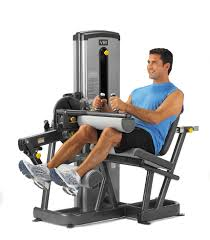
[1]

Seated Hamstring Curls - There are only 2 occasions that call for leg isolation exercises: 1) Recovering from an injury 2) Body building...and when was the last time you saw a body builder do something athletic?

[2]


INSTEAD
try Deadlifts


[3]

Pulldowns - Studies have shown that doing pull ups will increase the amount of weight you can use while performing a pulldown, conversely, increased pulldown capacity has not been shown to do the same for pullups. 'Nuff said.
[4]


INSTEAD try Eccentric Pullups


[5]


Tricep Kickbacks - The body positioning required by kickbacks cuts off potential range of motion and opens up more opportunities to cheat. 

[6]


INSTEAD try a Sphynx Pushup


[7]

Concentration Curls - Single arm isolation exercises are great...if you have 4 hours per day to spend at the gym. Not only do you get secondary bicep activation when you do real exercises like pullups and rows, but there are about a million more effective bicep exercises that don't make you look like a tool.


[8]
 INSTEAD try a Zottman Curl


[9]


Machine back extensions - I have tried this one at different stages of my fitness journey, and every time it feels awkward, uncomfortable and unnatural. That is because your lower back is not built to move independently of the rest of your posterior chain. Because it is easy to grip tight and cheat, people load up the weight on this exercise and risk injury for very little benefit.


[10]
 INSTEAD try Scorpion Extensions


@BrendanRolfe

Image Credits
[1]http://buffblogger.com/wp-content/uploads/2012/09/VR1-Seated-Leg-Curl_13060.jpg
[2]http://www.menshealth.com/mhlists/cms/uploads/1/barbell-deadlift_1.jpg
[3]http://www.carrienyden.com/wp-content/uploads/2010/02/lat-pulldown-start.jpg
[4]http://nicktumminello.com/wp-content/uploads/2013/12/pullup_negative.jpeg
[5]http://www.bodybuilding.com/exercises/exerciseImages/sequences/348/Female/m/348_2.jpg
[6]https://loseyoself.files.wordpress.com/2015/01/sphinx-pushup-garcia.jpg
[7]http://www.bodybuilding.com/exercises/exerciseImages/sequences/136/Male/l/136_1.jpg
[8]http://munfitnessblog.com/wp-content/uploads/2011/10/Zottman-Curl-Workout-Woman.jpg
[9]http://www.fitsociety.nl/wp-content/uploads/2013/10/back-extension1.jpg
[10]http://m.ufc.com/news/mma-power-training-cub-swanson


Tuesday, February 25, 2014

Dangerous gym exercises: Is the juice worth the squeeze?

[1]
                                                          
I am a firm believer that variety in the gym is the key to longevity. But I have been noticing, more and more, trainers and gym goers doing exercises that are extremely dangerous, and outside of a fun youtube video, offer little more than the opportunity for severe injury.

Any sport comes with an inherent level of risk. Anyone who has played contact sports knows that concussions at some point in their career are a virtual certainty. Even non-contact sports like basketball, soccer and baseball carry with them the possibility of a torn ligament from sudden change of direction, or joint risks, such as subluxation or torn labral tissues; from the application off-balance forces. Many athletes play the sports they love, accepting these risks for the chance to win a championship or graduate to the professional ranks.

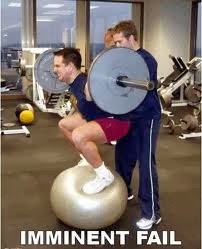
But where does that leave exercisers who are trying to lose weight or add muscle tone (the two most common goals of the average personal training client)? What purpose does a stability ball, barbell, back-squat serve[3]? It is virtually impossible to spot and adds uneeded complexity to an exercise that a minutiae of the population actually does flawlessly (the squat) on solid ground. You risk your client's health and well-being for something that looks impressive, but actually serves little to no purpose. I would not give this exercise to any of my athletes or clients because it has no application in sport or the real world. I also question the wisdom of introducing Jill or Joe Average to the Olympic lifts (unless they request it from you or show interest of their own volition). The clean, the snatch, and the clean and jerk are beautiful lifts when done properly. But these lifts are restricted to power sport athletes for good reason: 1) The average exerciser doesn't really the NEED power that these offer, 2) Power training for Joe Blow can be done under less technical and more controlled circumstances (dumbbells, kettlebells, body-weight, etc.), 3) This usually involves a lot of weight if you are seriously training for power. If they haven't MASTERED perfect form in the foundational lifts (Squat and Deadlift), then there is no way I am going to risk their spine, shoulders and knees, on lifts that are super technical and not applicable to their goals. It just doesn't make sense.

[2]                                                                                                                                                 [3]
                         
                                                     
I am all for changing up a routine and touching on as many of the foundational pillars of fitness as possible...but not all in one exercise. Resistance training, cardio training, balance training, and flexibility training are all an essential and supplementary part of any training program, and proper periodization of a program is not to be taken lightly (ie. first time exercisers should NEVER jump in to power training before progressing through: foundational movement, endurance, hypertrophy and strength training first).

Let's be honest, an effective workout program is founded on variations of 4 basic movements meant to improve strength: squat, push, pull, (vertical) press; consider it to be like a compass with each direction representing the direction of force. It takes months, if not years, to master perfect form in each discipline. Balance and coordination can then be added to variations of the exercise in a supplementary manner, but by no means should balance be done under extreme weight as stabilizer muscles are small and fatigue quickly. Exercises that are designed for power or strength, should be respected for their purpose. Instability saps power potential and will change the focus of your lift, effectively detraining the power athlete.


So before you want to do a show-stopper exercise at the gym, give a thought to the purpose of it and take a moment to weigh the risk versus the reward. Are complex olympic lifts really what your weight-loss client's program is lacking? Have you actually mastered the foundational lifts and are ready to progress to instability training under load? Are you using the exercise for its intended purpose? These are all questions you should ask yourself before going in to your next workout. Train with as much purpose as you do passion.

- Brendan Rolfe
Personal Training Specialist, Nutrition & Wellness Specialist, BA, DipA

Photo credits
1 http://www.liftingrevolution.com/dangerous-exercises-for-women-beginners-and-why-not-to-do-these/
http://muscle.iuhu.org/2014/01/must-watch-videos-with-hilarious-but-dangerous-things-which-gym-          newbies-do-how-not-to-perform-gym-exercises-at-various-machines/
http://www.reddit.com/r/Fitness/comments/1c8z8t/what_is_the_funniest_workout_you_have_ever_seen/