Showing posts with label injury. Show all posts

Thursday, March 19, 2015

If you're in pain, it's probably your own fault

...you just have to know how to listen...

No, I'm not talking about your last failed relationship. Your body is smarter than you, it will tell you when it's happy or unhappy, and you best be listening.

Tell your stupid ranch tooth to shut up
[1]
First, I want to address exercising. When you are exercising, there is body talk, and there is brain talk. More often than not, your brain gets in the way of a good workout. When you are 9 reps deep in to a 12 set, or 15 seconds from a minute interval sprint, there is a moment where you question whether you can reach your target. I don't care whether you are wet behind the ears or a power-lifter of 25 years, "can I do 1 more rep" encroaches your mind on every set. This is when your brain pipes up first and says, "better not, we could hurt ourselves, there's no shame in 9 reps." But guess what? Your brain can and will lie to you. It does it all day, every day. Your brain is responsible for the cant's and dont's in your life, and more often than not, it gets in the way of success. Your body can, and it will, as long as you bring focus and real effort to the last reps of each set.

So, the "can I's" come from your brain and stem from fatigue. I hope I have been clear in establishing that this voice is of no use to you and should be ignored. What you need to listen to is pain signals. Pain signals are different from discomfort signals and are easily recognizable. For instance, that burning feeling you get in your muscles is discomfort, that stinging sensation in your knee is pain. And in fact, the goal of working out is to achieve discomfort and keep pushing through it. Enduring discomfort will make you stronger (physically and mentally), but working through pain can cripple you. The answer is not to avoid anything potentially painful and to park your rear-end on the couch with a cool beverage. Try modifying the depth, execution or the exercise itself so that you can exercise without pain. Remember, the human body is built to move and thrives of adversity; use it or lose it.

[2]
Silence is golden
Eating: this is where my ass gets so chapped with both people's complaints, and niche-market products, that a bowl of Vaseline would not provide any relief. If you can't get through the day without products like Gaviscon, Beano, Tums, Rolaids, Pepsid AC, etc, you need to give your head a shake. The reason your body gets bloated, heart-burn, nausea, etc, is because it doesn't want you to ingest that crap! When was the last time anyone got heart-burn from cucumbers, brown rice, and baked salmon?!? Nevruary, that's when.

Instead of masking the symptoms of a pissed-off body, try listening to it instead. Further, every body is different; some people can get bloated from healthy food like apples, beans, yoghurt, etc. Listen to your body in this capacity as well. If these healthy foods bloat you, it is probably because there is something in them that does not agree with your chemistry. If everyone made it their goal to eat only foods that did not make them burp, fart, bloat, burn or drowsy, the developed world would not be facing the health epidemic in which we currently find ourselves.  

Home body
You may like to party HARD, but you will pay for your transgressions. I won't go too in depth on this one. I think most of us can say that we have felt the icy, steel toed boot of tough love in our ribs from a night (or 10) of partying. Just know that your body keeps a tab. Scarring on your liver, clouding of your lungs, clogging of your veins and intestines, etc, all result from the nights out that you don't remember. I'm not saying don't party, in fact, you will be relived to know that your body is a beast when it comes to repair and recovery, but you should know that if you don't treat it like a temple in between keg-stands, the effects can be cumulative. Around the 30 years mark, I have now been introduced to the magical 2-day hangover, which makes me carefully weigh the value of a night out to get loose, and necessity to be a grown up the next day and get stuff done.

[3]

The point is, your body talks to you and it doesn't lie. The sooner you are hearing it, and truly listening, the sooner you are happier and healthier. Like anything else in this world, you get out what you put in.

@BrendanRolfe

Image Credits
[1]http://drronhillchiropractic.com/wp-content/uploads/2012/10/depositphotos_10772870_m.jpg
[2]http://cdn.istoresinc.com/prankplace/images/fullsize/8311.jpg
[3]http://www.gifsforum.com/images/gif/party%20hard/grand/party-hard-eccbc87e4b5ce2fe28308fd9f2a7baf3-293.gif

Wednesday, February 26, 2014

Why you should be running naked (everyone is doing it!)


Less is more
When selecting your footwear, there are a lot of variables to think about (and you thought running was simple). For a long time, running shoes have been designed to offer extra arch support, added heel cushioning, and corrective shaping for issues like pronation. At a time when more is better, there is a movement gaining traction based on less. It is known as minimalist or barefoot running, and there is plenty of science to support its validity.
 
Minimalist Running
Before you get too excited, minimalist running is not the latest and greatest exercise fad from the nudist community. Minimalist or barefoot running embraces the natural mechanics of the body and is focused around footwear that offers the most minimal support possible (or none at all), allowing for maximal movement in the feet. The average running shoe has a sole thickness of around 24.0mm like the Nike Lunaracer, in contrast, the minimalist shoe, Vibram Five Fingers Speed model, has a sole thickness of 4.0mm at the heel. Critically, this extra 20.0mm of cushion prevents foot muscles from acting in a natural mobile fashion when exposed to a force (the ground). Inhibition of foot muscle movement is one point of contention in the conventional runners versus minimalist debate. The other point of debate is centred around heel drop, that is, the tendency of conventional running shoes to force a heel strike method of running because the heel is elevated from the ball of the foot by extra cushioning (often by a difference of 8mm or greater)[1]. 
http://demo.thexcartstore.com/xgear/Vibram-FiveFingers-KomodoSport-Multisport-Shoes-Men-s.html
 
A 2012 study using Harvard University runners found that those who "habitually rearfoot strike had approximately twice the rate of repetitive stress injuries than individuals who habitually forefoot strike”[2]. Of note, the footwear worn by research subjects actually dictated their running style in most cases. When presented with thicker soled runners, subjects used the traditional heel-strike method (landing each forward stride on your heel first), however, without any prompting, when test subjects were outfitted with minimalist shoes or were asked to run barefoot, they almost immediately assumed a more mechanically proper (and less impactful) landing that was on the ball of their foot (front of the foot). This achieves two things: 1) Landing on the ball of one’s foot dissipates foot strike forces throughout the leg muscles rather than focusing them in the knees 2) More calories are burnt by landing on the ball or your foot than using the heel-strike method[3]. If fitness and weight loss is your goal, calorie expenditure is paramount! 

A word of wisdom from personal experience, even to those who have been running for years: If you are going to try minimalist running, start at a distance no longer than 1km and work your way up. You will find some initial calf stiffness and/or soreness from the extra work they are getting.

I'm sorry there was no nudity in this article, you might say my title was misleading...

@BrendanRolfe

Works Cited

Tuesday, February 25, 2014

Dangerous gym exercises: Is the juice worth the squeeze?

[1]
                                                          
I am a firm believer that variety in the gym is the key to longevity. But I have been noticing, more and more, trainers and gym goers doing exercises that are extremely dangerous, and outside of a fun youtube video, offer little more than the opportunity for severe injury.

Any sport comes with an inherent level of risk. Anyone who has played contact sports knows that concussions at some point in their career are a virtual certainty. Even non-contact sports like basketball, soccer and baseball carry with them the possibility of a torn ligament from sudden change of direction, or joint risks, such as subluxation or torn labral tissues; from the application off-balance forces. Many athletes play the sports they love, accepting these risks for the chance to win a championship or graduate to the professional ranks.

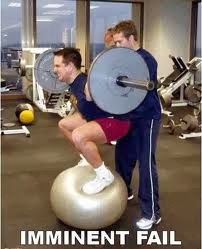
But where does that leave exercisers who are trying to lose weight or add muscle tone (the two most common goals of the average personal training client)? What purpose does a stability ball, barbell, back-squat serve[3]? It is virtually impossible to spot and adds uneeded complexity to an exercise that a minutiae of the population actually does flawlessly (the squat) on solid ground. You risk your client's health and well-being for something that looks impressive, but actually serves little to no purpose. I would not give this exercise to any of my athletes or clients because it has no application in sport or the real world. I also question the wisdom of introducing Jill or Joe Average to the Olympic lifts (unless they request it from you or show interest of their own volition). The clean, the snatch, and the clean and jerk are beautiful lifts when done properly. But these lifts are restricted to power sport athletes for good reason: 1) The average exerciser doesn't really the NEED power that these offer, 2) Power training for Joe Blow can be done under less technical and more controlled circumstances (dumbbells, kettlebells, body-weight, etc.), 3) This usually involves a lot of weight if you are seriously training for power. If they haven't MASTERED perfect form in the foundational lifts (Squat and Deadlift), then there is no way I am going to risk their spine, shoulders and knees, on lifts that are super technical and not applicable to their goals. It just doesn't make sense.

[2]                                                                                                                                                 [3]
                         
                                                     
I am all for changing up a routine and touching on as many of the foundational pillars of fitness as possible...but not all in one exercise. Resistance training, cardio training, balance training, and flexibility training are all an essential and supplementary part of any training program, and proper periodization of a program is not to be taken lightly (ie. first time exercisers should NEVER jump in to power training before progressing through: foundational movement, endurance, hypertrophy and strength training first).

Let's be honest, an effective workout program is founded on variations of 4 basic movements meant to improve strength: squat, push, pull, (vertical) press; consider it to be like a compass with each direction representing the direction of force. It takes months, if not years, to master perfect form in each discipline. Balance and coordination can then be added to variations of the exercise in a supplementary manner, but by no means should balance be done under extreme weight as stabilizer muscles are small and fatigue quickly. Exercises that are designed for power or strength, should be respected for their purpose. Instability saps power potential and will change the focus of your lift, effectively detraining the power athlete.


So before you want to do a show-stopper exercise at the gym, give a thought to the purpose of it and take a moment to weigh the risk versus the reward. Are complex olympic lifts really what your weight-loss client's program is lacking? Have you actually mastered the foundational lifts and are ready to progress to instability training under load? Are you using the exercise for its intended purpose? These are all questions you should ask yourself before going in to your next workout. Train with as much purpose as you do passion.

- Brendan Rolfe
Personal Training Specialist, Nutrition & Wellness Specialist, BA, DipA

Photo credits
1 http://www.liftingrevolution.com/dangerous-exercises-for-women-beginners-and-why-not-to-do-these/
2 http://muscle.iuhu.org/2014/01/must-watch-videos-with-hilarious-but-dangerous-things-which-gym-          newbies-do-how-not-to-perform-gym-exercises-at-various-machines/
3 http://www.reddit.com/r/Fitness/comments/1c8z8t/what_is_the_funniest_workout_you_have_ever_seen/